
Blog

Double Migration: Navigating the Intersection of Expat Life and LGBTQI+ Identity

Note: While this article focuses on international borders, it is also a faithful reflection for anyone migrating from a rural environment or small town to a big city in search of their true self. When you move to another country, it often seems like every difficulty will be logistical: finding a flat, opening a bank account, or dealing with local bureaucracy.However, if you identify as LGBTQI+, migrating is never just a simple change of address. It is frequently a double migration: a physical journey across borders and a deep emotional journey toward authenticity.Living abroad as a Queer Expat brings liberation, but it also carries invisible burdens. Facing culture shock while trying to be yourself in your new destination can make for a complicated landing in your mental wellbeing. The Mirror Metaphor: Leaving to Find Yourself For many LGBTQI+ individuals, living in another country is an unconscious act of self-defence or a deliberate attempt to gain freedom. In your place of origin, your identity grew up shaped by the expectations of your own system: your family, your school environment, or the conservative culture of your hometown. Often, the physical distance offered by expat life is the only way to silence that

Más info »

Expats and Systemic Perspectives: Why does Family still Affect Me so much Overseas?

We often think moving to another country is a purely individual act. You pack your bags, board a plane, and unpack your life in a completely new city. However, those of us who live or have lived abroad know all too well that physical distance is never a barrier for emotions. Have you ever hung up after a brief ten-minute video call with your parents or siblings, dragging a heavy sense of guilt, emotional overwhelm, or exhaustion? It is a deeply frustrating paradox for many expats: “If I don’t live there anymore, if I’m thousands of miles away building my own life, why does what happens at home still drain me so much?” The True Root: The answer isn’t a personal failure on your part. It lies in the very nature of the family systems we belong to. To truly understand it, we need to look at your history through the lens of Systemic Principles. The Crib Mobile Metaphor In the Systemic Approach, a family isn’t just a random collection of independent people; it functions exactly like a baby’s crib mobile. Imagine those tiny figures hanging over a crib, all interconnected by invisible threads. If you pull on one of

Más info »

The Expat Anchor: How to Rebuild Your Identity and Thrive Living Abroad

Moving abroad is often romanticised as an idyllic adventure, but the truth is, no one prepares you for the deep loneliness that hits when you turn off your laptop screen. From corporate executives working in multinationals to creatives reinventing themselves, those of us who leave our home countries share a core fundamental need: a safe space to talk in a language that actually connects with us emotionally. In this globalised world, expat emotional support is no longer a luxury; it sits right at the very centre of modern life. The True Challenge: Relocating isn’t just about changing your postcode or adapting to a new climate; you are completely restructuring your internal values, your roots, and your unique identity.As an Integrative Counsellor, I have spent the last 13 years living in the UK, completing my clinical training at various colleges in London. My Spanish roots allow me to practice interchangeably in both languages. For seven of those years, I split my time between my own private practice and strategic therapeutic work for various mental health charities in London—specifically Mind City and Hackney, London Friend, Mind in Enfield, and the CPPD Low-Cost counselling service. Merging that intense community-focused non-profit experience with international

Más info »

The Expat Reality Check: Navigating Culture Shock and the Silence of Isolation

Moving to another country is likely one of the bravest decisions you have ever made. However, you soon discover that the adventure goes far beyond learning a new language or changing your post code. Often, the initial excitement gives way to a profound feeling of not belonging and isolation.As an Expat, you are not just facing a new map; you are facing the challenge of managing uprootedness, the disorientation of your values, and an adaptation of your own identity. Expat loneliness arises precisely in that gap: where the host culture clashes with your personal history. Managing Culture Shock and Expat Loneliness Culture shock is not just about different mealtimes or weather; it is an internal process of loss and readjustment. On this journey, finding a professional who speaks your language and has personally experienced the Expat life makes all the difference. Counselling can provide a space of genuine empathy, where you don’t have to explain “why” you feel this way—because your counsellor has already walked a similar path. The Role of ACT in Adaptation Acceptance and Commitment Therapy (ACT) can be a very effective approach. Named as a “third-generation” approach, ACT teaches us to work from the “here and now”


Más info »

Internalized Homophobia: Self-Acceptance and Mental Health

We often hear that being lesbian, gay, or bisexual (LGB) is “socially accepted” and that there is no reason to complain because discrimination is a thing of the past. While it is true that significant progress has been made and there is greater acceptance than 20 years ago, it is still common in my practice to work with people under 30 facing rejection based on their sexual orientation or gender identity. Those of us who grew up in environments where our sexual identity was something to be hidden know that the reality is different. The process of accepting who we are is not linear; it is marked by an invisible norm: the presumption of heterosexuality and cisnormativity (the assumption that everyone identifies with the gender assigned at birth).This fear has a name: internalized homophobia. It is an invisible enemy that makes us believe a part of us is “defective,” when the true error lies in society’s failure to accept people for who they are.   The Levels of Homophobia: Where does Rejection come from? To understand this point, it is important to know that rejection doesn’t always come directly from one’s family or immediate circle. It stems from systemic levels

Más info »

What is Affirmative Therapy and Why is it Essential for the LGBTQ+ Community?

Often, living in a heteropatriarcal and binary society model forces LGBTQ+ individuals to face discrimination just for being different. Unfortunately, this often occurs even when they seek for mental health support. For this reason, affirmative therapy is considered the right choice.For the LGBTQ+ community, mental health is intrinsically linked to validation and the freedom to be oneself. However, many people in our community have suffered from a lack of understanding when working with therapists who, while well-intentioned, end up pathologizing their lives. I have experienced this pathologization myself.This is where LGBTQ-affirmative therapy marks a turning point, transforming the consultation into a safe space for empowerment and authenticity. Redefining support: beyond tolerance Unlike traditional therapeutic models, LGBTQ-affirmative therapy is not merely “friendly.” There is a clear line between an LGBTIQ+ friendly approach —where the professional simply does not discriminate— and the affirmative model, which is an intentional and empowering practice. In the latter, the therapist possesses a deep identity understanding, recognizing that your sexual orientation or gender identity are fundamental aspects of who we are, not problems that require a solution. Minority stress: when distress is social In our current social context, emotional distress often does not stem from the individual,

Más info »

The Art of Healing with Gold: Kintsugi, Acceptance, and the LGBTIQ+ Experience

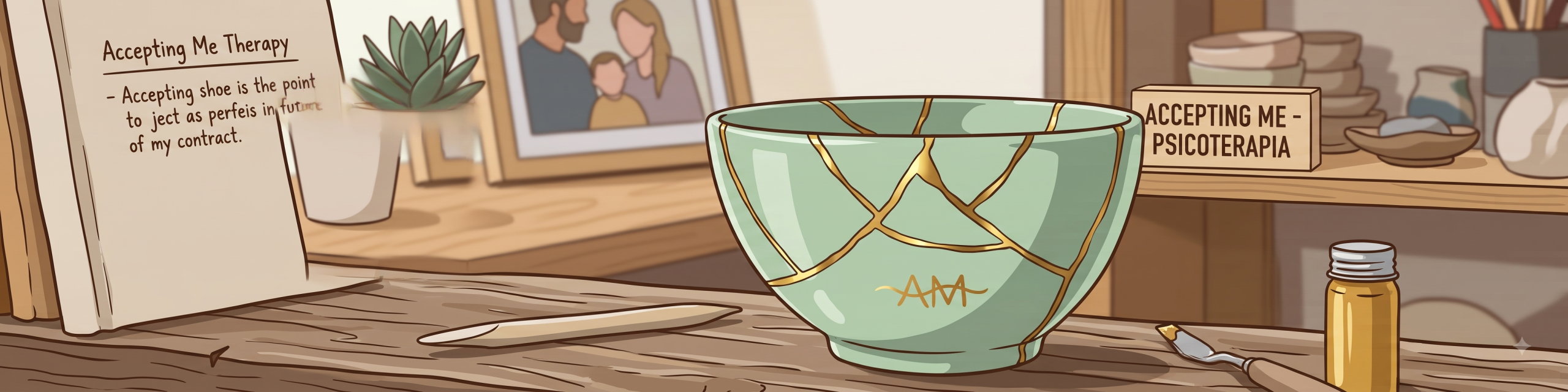
When I began my journey as a counsellor, I felt a deep need to find something I could truly identify with. I wanted to go beyond academic bibliography and that psychological bubble saturated with technical jargon that often feels distant and difficult to grasp. In my work, I use Metaphor as a vehicle to facilitate the process. Bringing emotional healing into an accessible language is my way of bringing the Therapeutic Process closer to those who trust me. In this article, I will intend to explore the spiritual and profound side that guides my work as an Integrative Therapist. I firmly believe that counselling is not a mechanical repair, but a human connection that transcends superficial relationships. In a world dictated by the mantra “you are what you have,” it is easy to end up feeling empty. When I welcome people into my practice, I discover that those external values are useless: they make us feel broken, difficult, and incomplete—above all, they create a profound lack of belonging. The broken vessel and the weight of the family system Often, our feeling of being “broken” comes from trying to fit into a mould that is not ours—one we likely did not choose. We

Más info »

Double Migration: Navigating the Intersection of Expat Life and LGBTQI+ Identity

Note: While this article focuses on international borders, it is also a faithful reflection for anyone migrating from a rural environment or small town to a big city in search of their true self. When you move to another country, it often seems like every difficulty will be logistical: finding a flat, opening a bank account, or dealing with local bureaucracy.However, if you identify as LGBTQI+, migrating is never just a simple change of address. It is frequently a double migration: a physical journey across borders and a deep emotional journey toward authenticity. Living abroad as a Queer Expat brings liberation, but it also carries invisible burdens. Facing culture shock while trying to be yourself in your new destination can make for a complicated landing in your mental wellbeing. The Mirror Metaphor: Leaving to Find Yourself For many LGBTQI+ individuals, living in another country is an unconscious act of self-defence or a deliberate attempt to gain freedom. In your place of origin, your identity grew up shaped by the expectations of your own system: your family, your school environment, or the conservative culture of your hometown. Often, the physical distance offered by expat life is the only way to silence

Más info »

Navigating Life Abroad: A Guide to Expat Counselling & Mental Wellbeing

Packing up your life and moving to another country is a beautifully bold move. If you value growth and autonomy, relocating abroad feels like the ultimate adventure—a chance for deep cultural immersion, a fresh start, or a massive leap in your career. But let’s be honest: beneath the exciting lifestyle updates, international life can get lonely. Once the initial novelty wears off, the reality of language barriers, subtle everyday misunderstandings, and being far from home can weigh heavily on you. When isolation creeps closer, expat counselling offers a safe, soft place to land, ground yourself, and truly learn how to thrive. What Exactly is Expat Counselling? At its core, expat counselling (also called expat therapy or international counselling) is therapy oriented for the unique reality of building a life outside your home country. An expat counsellor provides a confidential space to unpack the invisible weight that comes with moving across borders—struggles that friends and family back home might not fully grasp. A Space Free of Judgment for Capable Professionals If you are independent and used to solving your own problems, admitting that you’re struggling abroad can feel uncomfortable. You might feel guilty for feeling down when you have a good

Más info »

Why Expats Thrive with an Expat Counselor

What qualities should you look for in a counsellor to truly support you in your expat journey? For those living abroad, an expat counsellor brings unique expertise tailored to the distinct challenges of expatriate life.

Más info »